Summit yields 13 agreements spanning defense, AI, high-speed rail, critical minerals
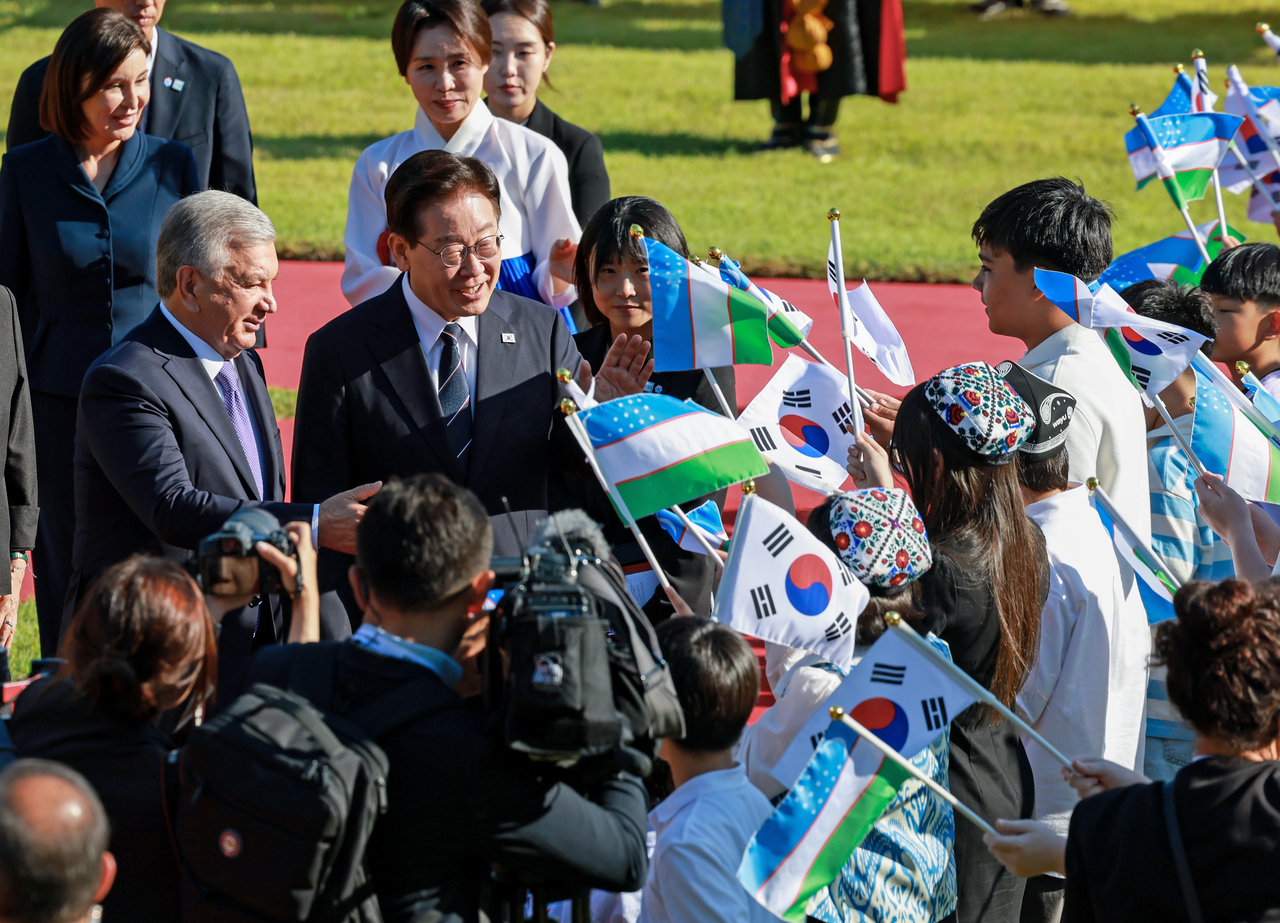
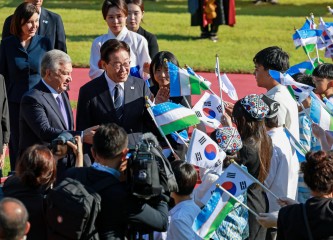
President Lee Jae Myung and Uzbek President Shavkat Mirziyoyev on Monday agreed to broaden the countries' bilateral partnership into emerging sectors including artificial intelligence, critical minerals and defense, seeking to create new engines of growth for both countries.
The two leaders emphasized expanding future-oriented cooperation by combining South Korea's technology and industrial strengths with Uzbekistan's development priorities and growing market during the summit in Seoul.
The meeting between Lee and Mirziyoyev marked the first in a series of bilateral summits with the leaders of five Central Asian countries — Kazakhstan, Kyrgyzstan, Tajikistan, Turkmenistan and Uzbekistan — ahead of the inaugural Korea-Central Asia Summit in Seoul.
The meetings come as Seoul pushes to expand diplomatic and economic ties with Central Asia, which it sees as taking on greater strategic importance amid shifting global supply chains and growing geopolitical uncertainty. Seoul views the region as an increasingly important partner as transport and logistics networks linking Europe and Asia gain significance and countries seek to diversify supply chains and markets.
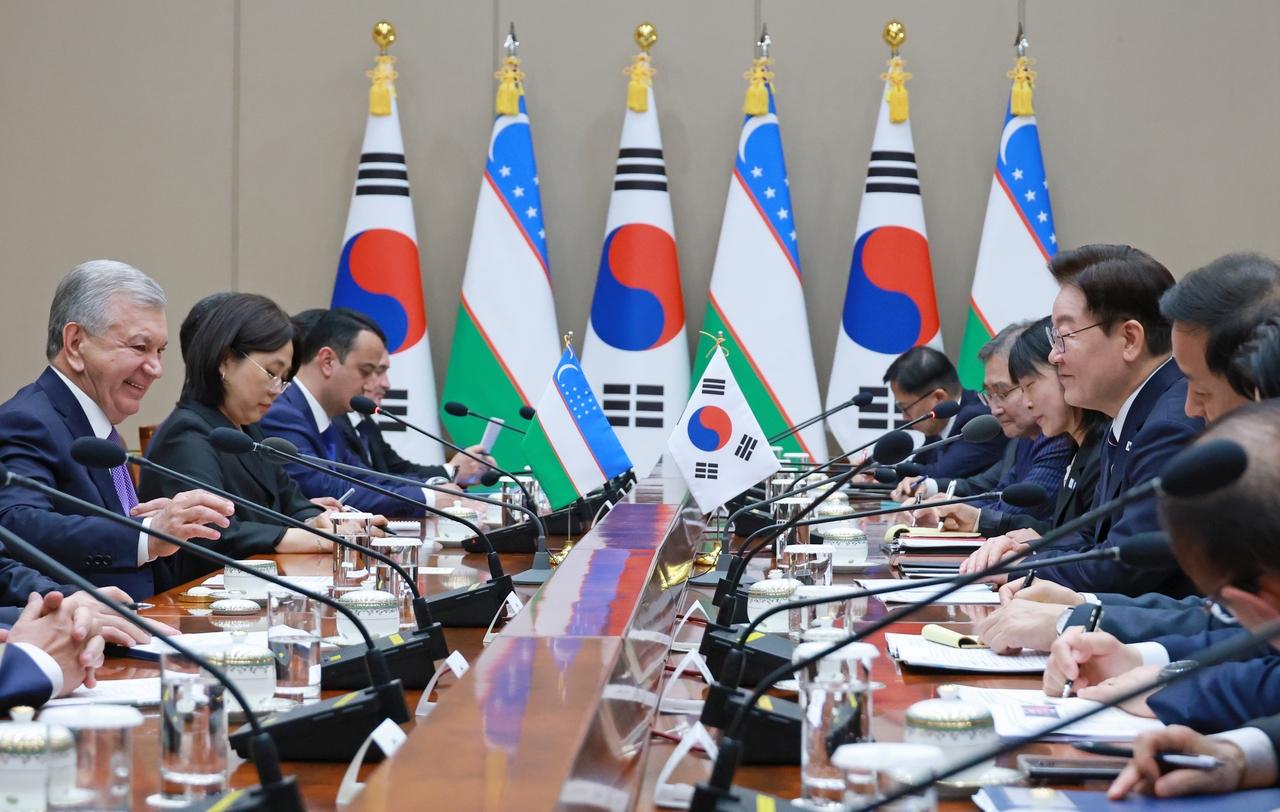
During the summit, Lee underlined the importance of South Korea's special strategic partnership with Uzbekistan, the only one of the five Central Asian countries to have established such a partnership with Seoul.
"I hope we can further substantively develop our special strategic partnership building on the deep friendship and trust that have accumulated between our two countries and move forward together toward a future of shared prosperity and peace," Lee told Mirziyoyev.
"We can broaden the horizons of mutually beneficial cooperation, from transportation infrastructure, healthcare and responses to the climate crisis to critical mineral supply chains, artificial intelligence and digital transformation, and defense, and together create new engines that will drive future growth."
Lee further underscored that "the role of Korea and Uzbekistan, which share friendship and trust, has become even more important at a time when uncertainty in the international situation is growing."
"I believe cooperation between our two countries will also be a major force for peace and stability in Eurasia and on the Korean Peninsula," Lee said.
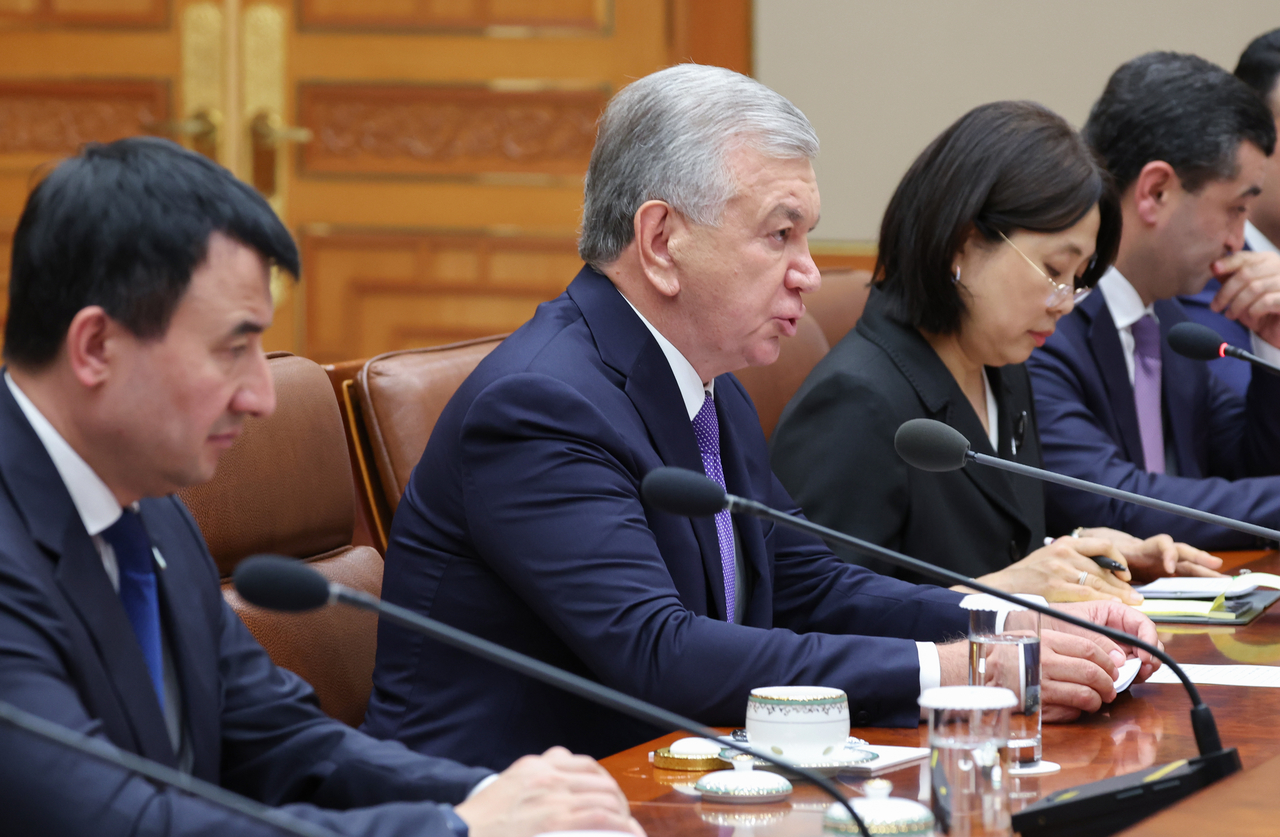
In response, Mirziyoyev, speaking through a Korean interpreter, expressed hope that his visit to Seoul would "inject new momentum into the special strategic partnership" between the two countries.
The Uzbek president reiterated that "our views and approaches are very close in addressing the challenges facing our two countries," adding that "the challenges and priorities of the two countries are closely aligned."
Mirziyoyev said Uzbekistan was closely watching Lee's policy drive "to build an economy centered on artificial intelligence and develop Korea into a global high-tech hub leading standards for the fourth industrial revolution."
Mirziyoyev also highlighted the depth of economic ties, noting that South Korea is one of Uzbekistan's major trading partners, with more than 700 South Korean companies operating joint ventures there and Korean investment continuing to grow.
Mirziyoyev said Korean experience and technology have been widely introduced across sectors including electronics and information technology, education, agriculture and healthcare.
On security, Mirziyoyev said Uzbekistan "will continue to unwaveringly support the Korean government's efforts to strengthen peace and security on the Korean Peninsula."
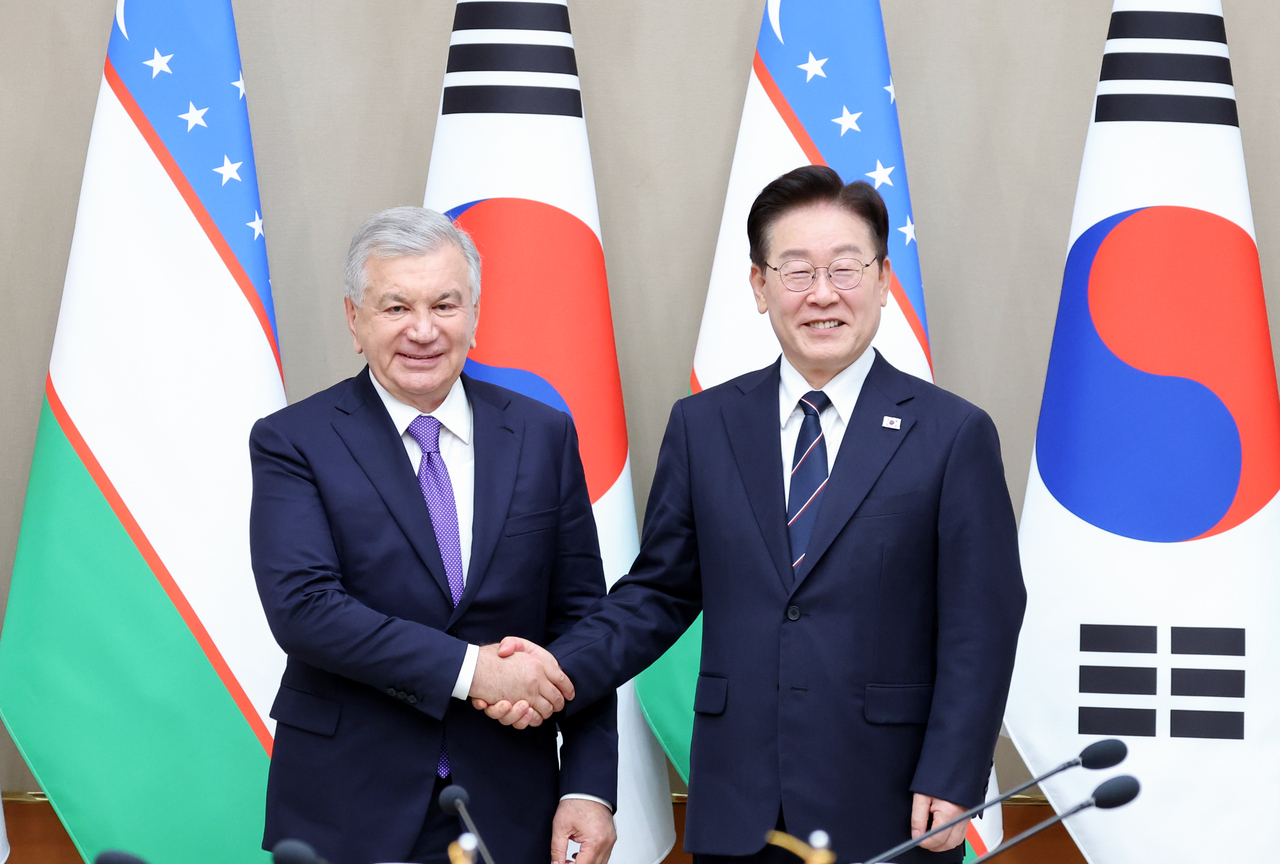
As an outcome of the summit, the two sides exchanged 13 agreements and memorandums of understanding in the presence of the two leaders, spanning infrastructure, healthcare, technology, education, tourism, agriculture, intellectual property, climate cooperation, medical regulation and development assistance.
Among the most substantive outcomes was a defense cooperation contract between Korea Aerospace Industries and Uzbekistan's Uztechtrade, aimed at expanding defense industry cooperation between the two countries.
The two sides also agreed to launch feasibility studies for Uzbekistan's planned acquisition of eight high-speed trains and the establishment of a national biobank and genomics center under South Korea's Economic Development Cooperation Fund.
Cheong Wa Dae further explained that the feasibility studies could pave the way for broader participation by South Korean companies.
Another memorandum seeks to expand bilateral digital manufacturing cooperation into AI-driven manufacturing innovation. It calls for cooperation in technology and knowledge sharing, workforce development, infrastructure and exchanges between companies.
The two countries also agreed to establish a framework for identifying and financing projects in six strategic industries prioritized by the Uzbek government, including critical minerals, AI and data centers, smart cities, a dedicated industrial complex for South Korean companies, pharmaceuticals and biotechnology, and food, beauty and content.
Separately, earlier Monday, Lee met Asian Development Bank President Masato Kanda to discuss ways to turn South Korea's expanding engagement with Central Asia into tangible projects through cooperation with the lender.
Lee proposed combining South Korea's technological and industrial capabilities with the ADB's project experience and financing tools to help stabilize critical mineral supply chains in Central Asia, including Uzbekistan, according to Cheong Wa Dae. Kanda said critical mineral supply chains were among the ADB's priority areas and expressed hope for closer cooperation with South Korea.
dagyumji@heraldcorp.com